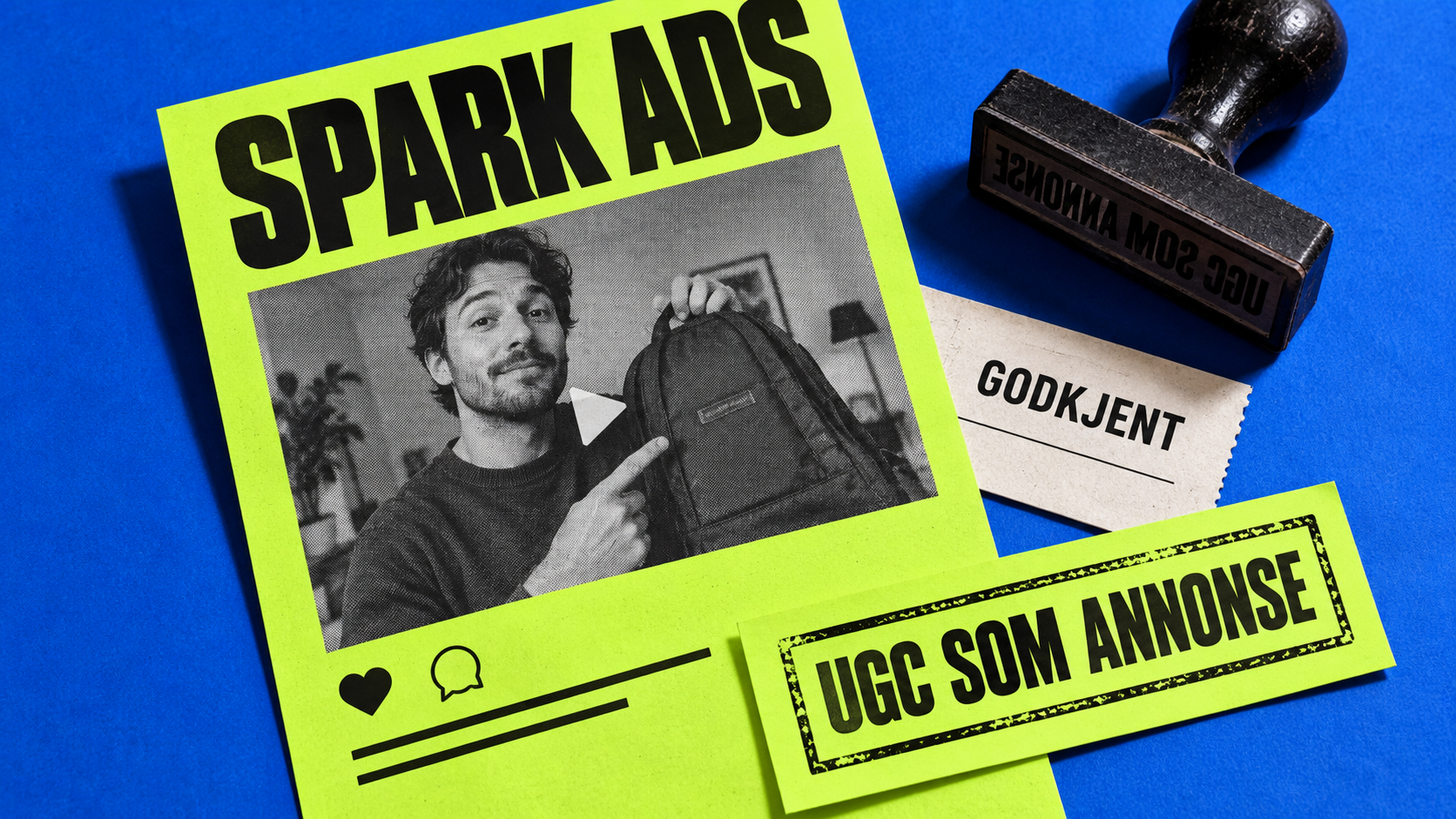
What is UGC? UGC stands for user-generated content: photos, videos and reviews made by ordinary people rather than by a brand or its agency. In marketing today it mostly means short, phone-shot videos that brands pay creators to make and then run as ads.
Start with a video you've definitely seen. A woman in her bathroom, a bit too early in the morning, holding up a serum and saying "okay, I was skeptical." The audio is from her phone. The light is from the window. No logo, no tagline, no voiceover telling you to order today. And you stop scrolling anyway, because it looks like something a friend would text you.
That's UGC. It's probably the most effective ad you scrolled past today, and it rarely looks like an ad at all.
- Meaning: UGC stands for user-generated content. Photos, videos and reviews made by regular people instead of an agency, which brands then use in their marketing.
- Two kinds: real, unpaid content from customers, and commissioned content from paid UGC creators that looks just as real. When a brand says "we need UGC" today, it almost always means the second.
- Why it works: it reads as a recommendation, not an ad, so it tends to outperform polished creative on TikTok, Meta and Snapchat.
- What it costs: roughly $50 to $500 per video in the US, with a median asking rate around $150. Usage rights for paid ads push the price up.
- The rules: paid content has to be disclosed. In the US, the FTC expects both creators and brands to know the rules.
We'll start with the word itself.
UGC meaning: three letters, two definitions
UGC has a small identity problem. Originally it meant exactly what the name says: content made by users. A customer leaving a review, tagging a store in their story, or filming an unboxing because they were genuinely happy with the order. Voluntary, unpaid, real.
Then marketers noticed that this kind of content performed better than the ads they were paying agencies to make. And, being marketers, they started ordering it.
Today, when a brand says "we need UGC," it almost always means the other version: videos and photos made on assignment by a UGC creator, shot to look like customer content, but paid for by the brand and run as ads. Both are called UGC. It's the paid version that has turned into a job, and it's the reason most people search for the term.
What the two share is the look. UGC isn't supposed to look like a glossy commercial. It's supposed to look like something a real person posted. The day it starts looking like an ad, it stops working.
What is user generated content, and what counts?
More than most people think. All of this is user generated content:
Reviews and ratings. The oldest form, and still the one most buying decisions pass through.
Customer photos and videos. Someone tagging the brand in a story, filming the package being opened, or posting results after three weeks of use.
Commissioned creator videos. Filmed by a UGC creator on a brief and a fee, but in the same everyday tone as customer content.
Comments, posts and threads. Text counts too, even if video is what ends up in the ad budget.
The common thread is simple: someone outside the brand's marketing team made it, and you can tell.
UGC creator, influencer, content creator: what's the difference?
People mix these up constantly, including people who work in the industry. The split is actually simple, and it comes down to what you're paying for.
An influencer sells reach. She has followers, you pay to reach them, and the content lives on her account. The price tracks her audience size.
A UGC creator sells content. She doesn't need a single follower. She makes the video, delivers the file, and you decide where it runs. Usually in your own ads.
Content creator is the umbrella over both, plus everyone making content for their own account without getting paid for it.
In practice the roles blur. Plenty of creators do both, and the smartest brands combine them: the creator posts on her own account, and the brand runs the same video as an ad from the creator's profile. Meta calls that partnership ads, TikTok calls it Spark Ads, and the industry called it whitelisting for years. The full comparison, with prices and when to use which, is in UGC vs influencer marketing.
Why do we trust a stranger in her bathroom more than an ad agency?
Because we always have. Nielsen's global survey on trust in advertising is almost embarrassing reading for the ad industry: 92% of consumers said they trust recommendations from friends and family, and 70% trusted consumer opinions posted online. Traditional advertising sat well behind both. The study is old, but nothing in how people scroll today suggests the ranking has flipped.
UGC borrows that trust. A person holding the product and explaining why it works hits something a studio production can't. Not because the studio version is bad, but because we know exactly what it is.
Then there are the practical reasons, which are the ones that actually move budgets. UGC performs well as paid creative on Meta, TikTok and Snapchat, where it competes against regular posts in the feed. It's cheaper and faster to make than a commercial. And it scales in a way a commercial never will: one shoot gives you one file. Ten creators each delivering three videos a month gives you thirty new ads to test, each with its own face, angle and audience. Nine of them flop. The tenth pays for all of them.
UGC content: the formats that show up in your feed
Most UGC content is video. Short, vertical, 15 to 45 seconds. Unboxings. Demos. Before and after. "Day in my life." The honest first reaction, which is the genre our bathroom serum video belongs to. What decides whether a video sells is rarely the camera. It's the structure: what happens in the first two seconds, and whether there's a reason to buy when it ends. Ten of these formats, with hook lines and script skeletons, are in our guide to UGC examples.
UGC photos are underrated. The product on a kitchen counter, in a bag, in natural light, not on a white background. Online stores use them on product pages, in email and in ads, and a set of twenty photos can cover a year of needs for a fraction of what a studio shoot costs.
UGC ads are what happens when the brand takes the video and pays to show it to people who have never heard of the creator. That's the most common use today, and it's where the money is for most creators. It's also why usage rights matter so much, which we cover in detail in our guide to UGC usage rights.
And then there are partnership ads and Spark Ads, where the ad runs from the creator's own profile instead of the brand's. Her name, her photo, her followers in the comments. It looks like a regular post because technically it is one. Results are often better, and the price is higher, for exactly that reason.
What does UGC cost?
Ask three people and you'll get three answers. All three are correct.
Flat fee per deliverable. The creator gets an agreed amount for an agreed number of videos by a deadline. Simple, predictable, and the brand pays the same for the video that flopped as for the one that sold.
Commission per sale. The creator gets a share of the sales her content drives, measured through a trackable link. The brand takes almost no risk. The creator has no ceiling when a video hits. The model needs one thing a surprising number of brands don't have: a way to actually trace the sale back to the creator.
Retainer. A fixed monthly amount for a fixed number of approved deliverables, often with commission or a bonus on top. That's the model for relationships meant to last, with creators who deliver consistently.
Most brands end up with a mix, and the trade-offs of each model are in how to pay influencers and UGC creators. On price, US rates run from around $50 per video for beginners to $500 and up for experienced creators, and inBeat's analysis puts the median asking rate at $150 per video. The full breakdown, by creator level and deliverable, is in our guide to UGC rates.
Whatever the model, one variable matters more than any other, and new creators almost never talk about it: usage rights. Is the video for organic posts, or paid ads? Thirty days, or a year? From the brand's account, or the creator's? A video that runs as a paid ad from the creator's profile for six months is not the same deliverable as one organic post, even if the file is identical. The broader the use, the higher the price. Get it in writing before the first file is delivered.
UGC marketing in the US right now
UGC marketing has gone from something a handful of agencies did to a standing line in the ad budget for a growing number of online stores. The audience is there: according to Pew Research Center's 2025 survey, 84% of US adults use YouTube, 71% use Facebook, 50% use Instagram and 37% use TikTok. Every one of those feeds is full of short, vertical, phone-shot video, and that's the format UGC was built for.
What stands out right now is volume. The US market has more creators than any other, which is good news for brands that want variety and bad news for brands that pick creators on vibes. A portfolio tells you someone can hold a camera. It doesn't tell you whether their videos sell.
That's the gap worth closing. Not "do we have UGC," but "do we know which UGC made money."
Where do you find UGC creators?
Brands have had two options for a long time, and both have a catch.
You can find them yourself. Scroll TikTok and Instagram, send DMs, agree on a brief, ship product, write a contract, receive an invoice, pay. Multiply by ten creators. It's cheapest in dollars and most expensive in hours, and you learn nothing about who makes content that sells until you've already paid everyone.
You can use an agency. The agency does everything. You pay for it being done, whether or not the content sold anything, and the price reflects that someone between you and the creator needs a salary.
The third route is a marketplace. You post a program with a brief, a payment model and products. Creators apply. Terms, rights, product shipping and payouts are built in, so you skip ten separate contracts. On Attribyte it's free to start, with no monthly fee, and you can choose to pay on results so creators are rewarded as their content actually drives sales. What's different from the other two routes is what you see before you choose: the portfolio, the creator's connected TikTok, Instagram and Snapchat accounts, and what the creator has delivered before. And once a campaign is live, you see which creator and which video are driving sales, not just that sales went up. The full process, from search to a vetting checklist, is in how to find and hire UGC creators.
Want to become a UGC creator?
You don't need followers. You need a phone with a decent camera, two or three sample videos for products you actually use, and gigs found through the same channels brands use to hire. Treat it as a business from the day it earns money, not from the day the IRS asks about it. The full picture of what the role involves is in what is a UGC creator.
The boring chapter that saves you trouble
Two things to get right in the US, whichever side of the table you're on. Neither is fun. Both are cheaper to fix before than after.
Disclosure. If a creator posts sponsored content on her own account, the FTC expects it to be disclosed clearly. Its guide for influencers says to use plain words like "ad" or "sponsored", place the disclosure with the endorsement itself, and not rely only on a platform's built-in tool. Free product counts as a material connection too. When the brand runs the video as an ad from its own ad account, the platform labels it. Put the requirement in the brief and it's handled.
Rights. Organic UGC from customers can't be used in ads without permission, no matter how good the photo is. Commissioned UGC comes with agreed usage rights. Without a written agreement, neither side has anything to point to the day there's a disagreement, and that day comes more often than people expect.
The big question: does it actually sell?
Here's where most brands end up after a couple of months of UGC. They have ten videos from five creators running on Meta, TikTok and Snapchat. Sales are up. Everyone's happy. And nobody can say which video did it.
The ad platforms don't help. Meta, TikTok and Snapchat each report their own numbers, with their own attribution windows, and they will happily all take credit for the same sale. Add up the revenue the three platforms claim and you get a number well above what actually went through checkout. Then budget goes to whoever feels right, and creators get paid based on who was nicest in the DMs.
The fix isn't complicated, but you have to do it. Give every creator and every piece of content its own trackable link. Measure sales in your own store, not in the ad platform. Then you can see in black and white which video converts, and work out the real ROI of your creator spend.
That's what Attribyte is built for. When a video is approved, it gets its own link that follows the content wherever it ends up: in the creator's own TikTok post, in her bio, in the brand's ad on Meta or Snapchat, or in a Spark Ad run from her profile. Sales are measured in the brand's Shopify store with 7-day last-click attribution, so it's the store's number, not the platform's. The brand sees sales, ROAS and conversion per creator and per video, across organic and paid, and can do three things that used to be guesswork: put budget behind what sells, pay creators for what they actually drive, and order more of what works. The creator sees the same numbers from her side, and gets paid automatically.
That's the difference between using UGC and knowing it pays off.
So, what is UGC?
It's advertising that works because it doesn't look like advertising. It's a job that barely existed five years ago. It's the reason a woman in her bathroom at 7 a.m. sells more serum than an agency with a six-figure budget.
And for brands and creators alike, it's still early enough. The winners won't be the ones who make the most UGC. They'll be the ones who know which UGC sold, and make more of exactly that.
Frequently asked questions
What does UGC stand for?
UGC stands for user-generated content. It's used both for content customers create on their own and for content brands commission from UGC creators to use in their marketing.
What is UGC content in marketing?
In marketing, UGC content usually means short, phone-shot videos and photos that look like a real customer's post and that the brand runs as ads or uses on product pages and in email. Most of it today is commissioned from paid creators rather than collected from customers.
What is the difference between UGC and influencer marketing?
An influencer is paid for reach and posts on her own account. UGC is about the content itself: the brand pays for the video and distributes it, usually as ads, regardless of how many followers the creator has.
How much does a UGC video cost?
In the US, roughly $50 per video for beginners up to $500 or more for experienced creators, with a median asking rate around $150. Rights to run the video in paid ads, or from the creator's profile, add to that. See our guide to UGC rates.
Can brands use customer UGC for free?
Not in ads without permission. A customer's post belongs to the customer. Commissioned UGC comes with agreed usage rights that define where and how long the brand can use it.
How do I know if UGC is actually selling?
Give every creator and every video a trackable link, and measure sales in your own store instead of in the ad platform. Then you can see which video and which creator drive revenue, whether the video was posted organically or run as an ad.