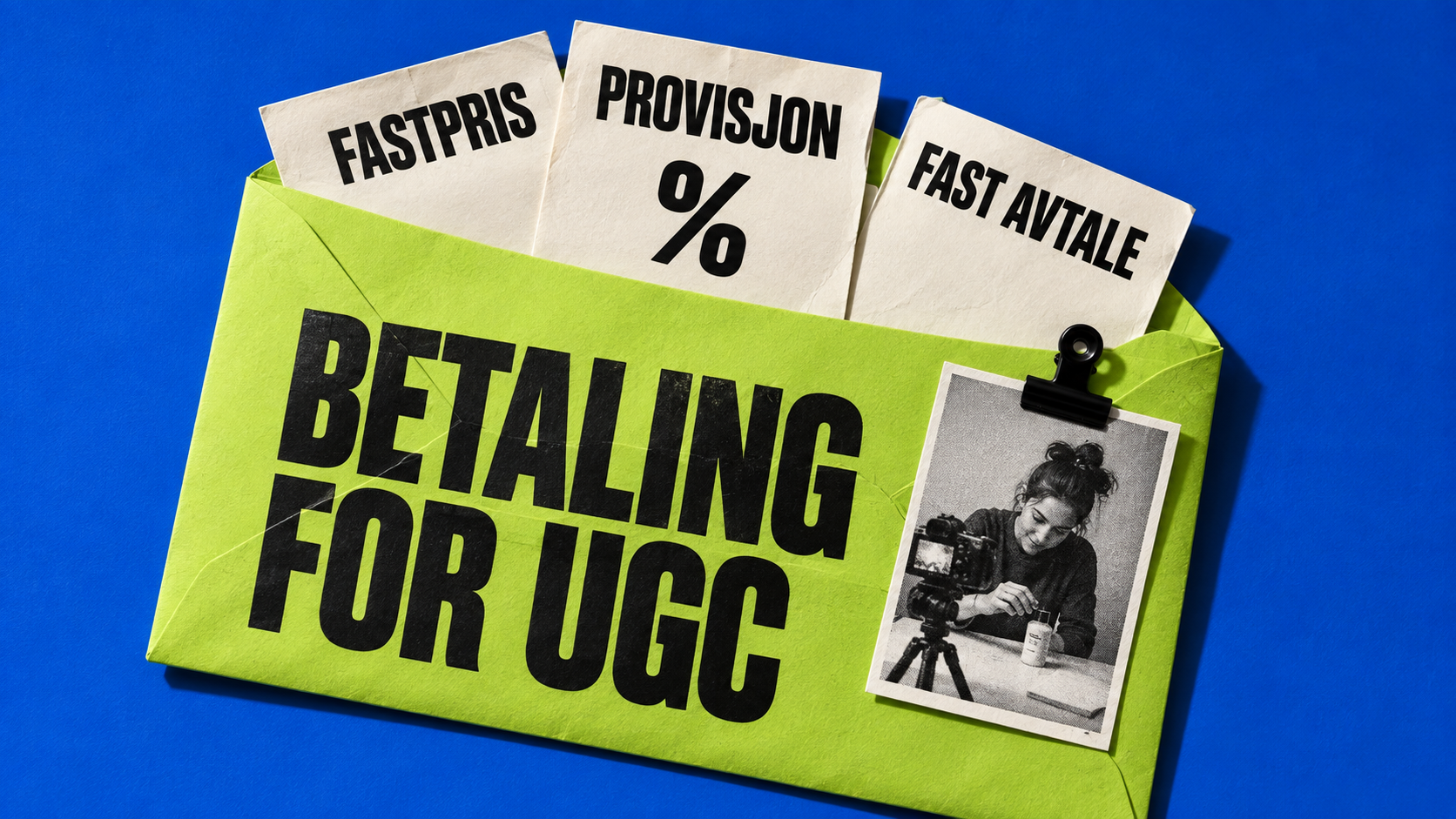
Brands pay influencers and UGC creators in one of five ways: a flat fee per video, commission on the sales the content drives, a monthly retainer, a bonus, or pay per organic view. Most deals combine two of them.
Most brands ask the wrong question first. They ask "what does a UGC video cost?" when the question that decides both the price and the result is "how are we going to pay for it?" A flat fee and a commission deal can produce the exact same video, with completely different motivation on the creator's side and completely different risk on yours.
So here is how to pay influencers and UGC creators in 2026: the five payment models brands actually use, when each one fits, and the admin that trips up US brands paying freelancers for the first time.
How influencers get paid, in short
- Flat fee per deliverable: an agreed amount per approved video. Predictable, and the normal starting point for a new partnership.
- Commission on sales: the creator earns a share of the sales their content drives. Low risk for you, but only works if sales can be tracked per video.
- Retainer: a fixed monthly amount for a set number of deliverables. For partnerships that have already proven themselves.
- Bonus: extra money for on-time delivery or content that hits a target, usually stacked on top of another model.
- Pay per organic view: the fee follows the reach of posts on the creator's own accounts.
- The admin (US): collect a Form W-9 before the first payment, and file a 1099-NEC for any contractor you pay $2,000 or more in a year.
First: you are paying for two things
A UGC video has two price tags. One is production: someone films, talks to camera and delivers a finished file. The other is usage rights: permission to use that video on specific channels, for a specific period, organically or in paid ads.
Get this straight before picking a model, because the rights are often worth more than the filming. A video you will run as a paid ad for a year is a different deal from one organic post, even if the file is identical. Launchpoint's 2026 pricing guide, for example, puts entry-level creators at $50 to $150 per video and mid-level creators at $150 to $300, and adds 30 to 50% of the base rate for 30 to 90 days of paid ad usage and 100 to 150% for a perpetual buyout. The full price picture is in our guide to UGC rates.
How do influencers get paid? The five models
1. Flat fee per deliverable
The simplest model, and the one most brands start with. The creator gets an agreed amount for an agreed number of videos by a deadline, regardless of how the videos perform later.
The upside is predictability: you know the cost before you order, and the bookkeeping is simple. The downside is that you carry all the risk. You pay the same for the video nobody bought from as for the one that became your best seller. For testing a new creator, or when the video goes into paid ads where the media budget matters more than the creator, a flat fee is usually the right call.
2. Commission on sales
Here the creator earns a percentage of the sales the video actually drives, measured through a trackable link. It flips the risk: you pay as the content earns its money back, and the creator has no ceiling when a video hits.
The model has one requirement that a surprising number of brands miss: sales must be traceable to the right creator and the right video. Without that, commission turns into an argument about who deserves the credit. With tracking in place, it is the fairest model there is, because it pays for results rather than effort. How to set up that measurement is covered in influencer marketing ROI.
Commission works best for products with broad appeal and a price point where people buy on impulse. If you sell considered purchases with a long decision cycle, a single video rarely produces a trackable sale inside the attribution window.
3. Retainer
When a partnership is meant to last, one-off orders get tedious. A retainer is a fixed monthly amount for a fixed number of approved deliverables, often with commission or a bonus on top. The creator gets predictable income and learns your brand properly, and you get a steady flow of fresh content without renegotiating every time.
A retainer is a commitment, though. It makes sense once you have found one or two creators who deliver consistently and you know you need new content every month. Starting a brand new partnership on a retainer is buying a subscription to something you haven't tasted.
4. Bonus
A bonus is rarely a model on its own. It is an add-on that pushes motivation in the right direction. Two versions are common: a submission bonus for delivering complete and on time, often for the first ten or so videos, and a performance bonus for content that hits a target, like a set number of sales.
The submission bonus solves a real problem in commission deals. A creator asked to work on pure commission for a brand she has never worked with carries all the risk in the first weeks, before anyone knows whether the product sells. A fixed bonus for the first batch of videos pays for the work while the data builds up. After that, commission can take over.
5. Pay per organic view
The fifth model ties the fee to reach: the creator posts on their own profile and gets paid on how many views the content gets. It rewards creators who are good at working the algorithm and fits campaigns where the goal is awareness and social proof rather than direct sales, which puts it closer to classic influencer marketing than to UGC (the difference is explained in UGC vs influencer). The requirement is the same as for commission: the numbers have to come from a source both sides trust, not screenshots sent back and forth.
Which influencer payment model when?
| Situation | Model that fits |
|---|---|
| Testing a new creator | Flat fee, one to three videos |
| You want to pay for results, not effort | Commission on sales (needs tracking) |
| Creator won't take pure commission yet | Commission plus a submission bonus |
| Steady need for new content | Retainer, often with commission on top |
| Goal is reach and awareness | Pay per organic view |
Most brands combine. A common path: start three creators on a submission bonus plus commission, see after a month who actually drives sales, and offer the best one a retainer. That way you never pay long for content that doesn't work, and the good creator ends up with the predictable income she earned.
How to pay influencers in the US: the paperwork
Whatever model you pick, the money is taxable income for the creator, and as the payer you have a few jobs. This is general information, not tax advice. Check your own situation with an accountant.
Collect a W-9 before the first payment. A UGC creator is almost always an independent contractor, not an employee. Ask for a Form W-9 so you have their legal name and taxpayer ID on file. If a creator won't provide a TIN, the IRS instructions say you must backup withhold on reportable payments. If you set hours, supply equipment and control how the work is done, check the IRS rules on contractor versus employee before assuming.
File a 1099-NEC above the threshold. For payments made from 2026, the reporting threshold for nonemployee compensation rose from $600 to $2,000, with inflation adjustments starting in 2027. Pay a creator $2,000 or more in a year and you file a 1099-NEC. One exception worth knowing: payments by credit card or through a third-party payment network are reported by the payment company on Form 1099-K, not by you on a 1099-NEC.
Free product is payment too. Gifting is where most brands get sloppy. The IRS says the fair market value of goods received in exchange for services counts as income, so a box of product in exchange for a video is not free for the creator. And for posts on the creator's own account, the FTC is clear that free or discounted products create a material connection that has to be disclosed.
Write it down before the first video. Amount, model, deliverables, deadline, usage rights and when payment happens. "On approval" and "net 30 after month end" are very different cash positions for a creator doing this full time. Our influencer contract template has ready clauses for flat fee, commission and retainer deals.
The part that decides everything: know what you are paying for
Whatever the model, one thing separates brands that pay smart from brands that pay blind: they know which video and which creator drove the sale. Without that, you end up paying most to whoever was nicest in the DMs and splitting budget on gut feeling.
The ad platforms won't solve this for you. Meta, TikTok and Snapchat will happily all claim credit for the same sale. The fix is to give every creator and every piece of content its own trackable link and measure sales in your own store. Then you can pay commission fairly, bonus the people who earned it, and order more of what works, whether it runs as Spark Ads or partnership ads on Meta.
Using an influencer payment platform
Most of the friction comes from payment, tracking and agreement living in different places: the amount in a DM, sales in a spreadsheet, the invoice in an email. An influencer payment platform puts them in one place.
On Attribyte, you pick the payment model when you create a program, so the terms are clear before a creator applies: flat fee, commission, retainer, bonus or pay per organic view. Every approved video gets its own trackable link that follows the content everywhere, in organic posts and in your ads on Meta, TikTok and Snapchat. Sales are measured in your Shopify store with 7-day last click, and each order is credited once. Creators see their own numbers and get paid automatically through Stripe, with no invoices to chase.
It is free to start with no monthly fee, and the platform fee follows the model: 1.5% of Attribyte-attributed sales on commission programs, 10% of the creator payout on flat fee or per lead, and 3% on retainers, organic views and one-off bonuses. You are never charged twice on the same sale.
Frequently asked questions
How do influencers get paid?
Through one of five models: a flat fee per video, commission on the sales their content drives, a monthly retainer, bonuses for delivery or performance, or pay per organic view. Many deals combine a base fee with commission or a bonus so both sides share the risk and the upside.
Should I pay a flat fee or commission?
A flat fee fits testing and first partnerships, where you want predictability. Commission fits when you want to pay for results and have per-video tracking in place. Commission plus a submission bonus is a good middle ground when a creator won't work on pure commission yet.
Do I need to send a 1099 to influencers?
If the creator is a US contractor and you pay them $2,000 or more in a year (for payments made from 2026), you file a Form 1099-NEC. Payments through card networks or third-party payment platforms are generally reported on Form 1099-K by the payment company instead. Collect a W-9 up front either way.
Can I pay creators with free products only?
You can, but it rarely works well. Product received for services is taxable income for the creator, it still requires ad disclosure, and the creators willing to work for product only are usually the newest. If you want quality and consistency, money is part of the deal.
What is the best influencer payment platform?
The one that ties payment to tracked results. Look for per-video tracking links, sales measured in your own store rather than in the ad platforms, automatic payouts, and support for more than one payment model so you can move a creator from test to commission to retainer without switching tools.