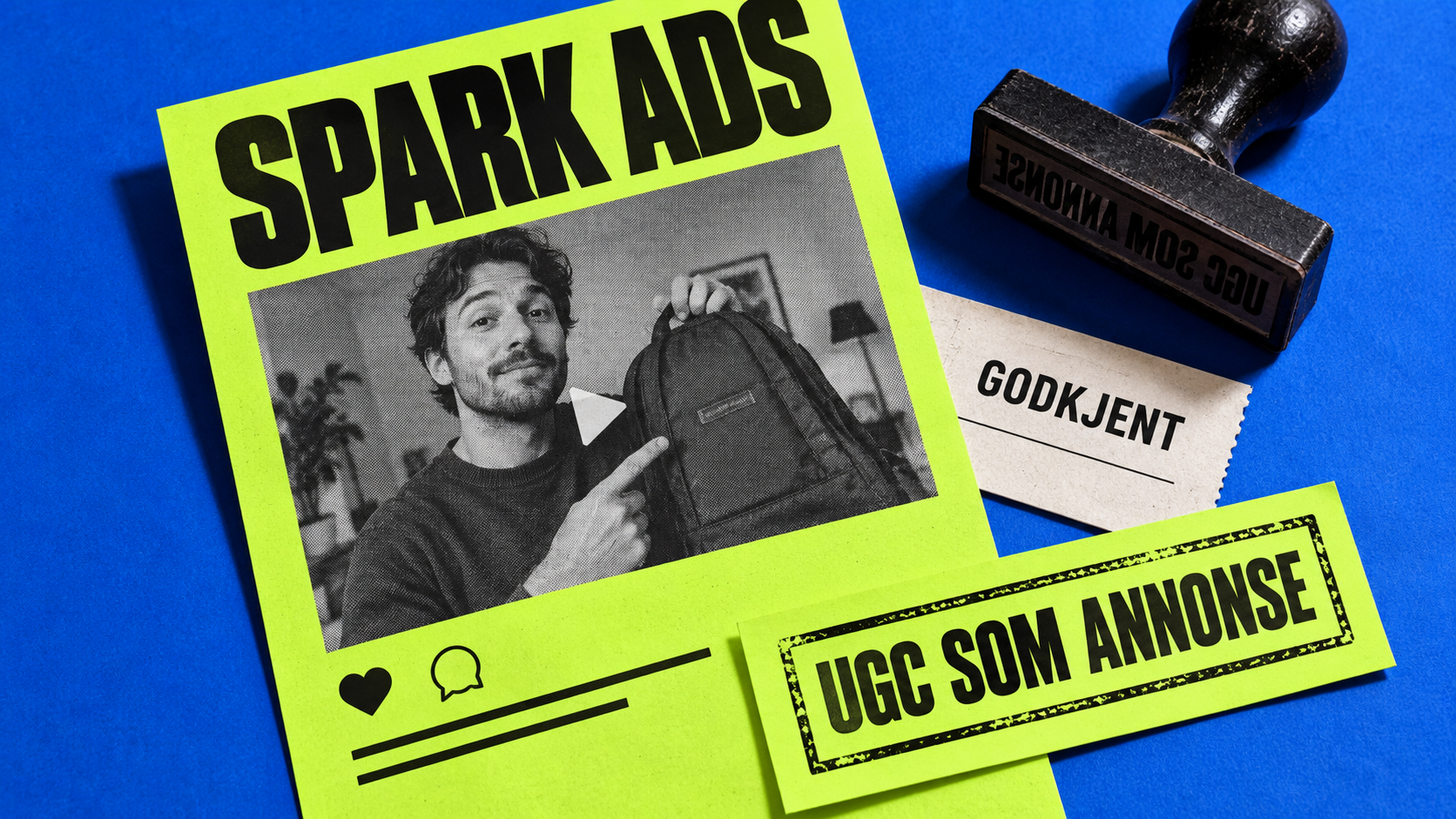
UGC ads are paid social ads built from videos or photos made by creators or customers instead of studio commercials. On Facebook and Instagram they should be the easy win. You did the hard part. You found a few creators, paid for eight videos, and they are genuinely good: real faces, natural light, the product on a kitchen counter that looks like your customer's. Then you uploaded them to Meta, hit "Boost post", and got what most brands get. Some reach. A few likes. Almost no sales.
The video is rarely the problem. The way it runs in Meta usually is.
This is a practical guide to UGC ads for online stores that already have creator content, or are about to buy some, and want it to sell on Facebook and Instagram. If you need the basics first, start with what UGC is and what a UGC creator does.
Short answer: UGC ads are paid ads on Facebook and Instagram built from video or photos made by creators, instead of polished brand commercials.
- Format: vertical 9:16 video for Reels and Stories, 4:5 for feed, and usually well under 60 seconds.
- The opening: the first two seconds decide whether Meta shows the ad to more people. Add captions, because plenty of people scroll with the sound off.
- Volume beats polish: in one analysis of 65,000 Meta ads, only about one in five became a winner, and winners faded after roughly 36 days.
- Two ways to run them: from your own brand account, or from the creator's profile as a partnership ad.
- Measurement: give every video its own trackable link and measure sales in your own store, not in Ads Manager.
Why UGC advertising works on Meta
Meta is still where most online shoppers are reachable at scale. Pew Research Center's 2025 survey found that 71% of U.S. adults use Facebook and half use Instagram, and about half of adults visit Facebook at least once a day. People on these apps browse, compare and buy. They are not only there to be entertained.
But the feed is crowded, and your ad is not competing with other ads. It is competing with photos of friends' kids and weddings. A polished commercial loses that fight in half a second, because the brain recognizes "advertising" and scrolls on before the product name is said. A UGC ad does not trigger that reflex as fast. It looks like the rest of the feed, and that is why it gets watched.
UGC advertising is not magic. It is simply the format the feed lets through.
The format Meta actually wants
This is where most brands lose money without noticing. A video shot in the wrong format either gets cropped so the creator's head disappears, or shows up with black bars that scream "this doesn't belong here". The recommended specs per placement:
| Placement | Aspect ratio | Length |
|---|---|---|
| Instagram Reels | 9:16 (1080 × 1920) | Shorter performs better |
| Instagram Stories | 9:16 | 1 to 60 seconds |
| Instagram feed | 4:5 | Under 60 seconds |
| Facebook feed | 1:1 or 4:5 | Under 60 seconds |
The practical rule: shoot vertical from the start, in 9:16, so you cover Reels and Stories, and let Meta crop to 4:5 for feed. Keep the product, the face and any on-screen text in the middle of the frame, away from the top and bottom edges where Meta lays buttons, captions and the profile name over the video. And caption everything. A UGC video ad that only makes sense with sound on is one most people will never understand.
The first two seconds decide everything else
Meta shows a new ad to a small audience first and lets their reaction decide whether it gets more delivery. If people drop off in the opening, the ad is dead before it had a chance. The first seconds are not an intro. They are the whole job.
The structure that keeps winning in UGC ads is simple: hook, problem, solution, call to action. A hook in the first two seconds (a result shown before the explanation, a question the viewer recognizes, or a claim that forces a "wait, what?"). Then the problem it solves, then the product as the answer, and finally one clear reason to buy now. A creator introducing themselves, or a logo, is not a hook. To see which openings actually stop the scroll, track hook rate per video. For ready-made hooks and script skeletons by format, see our UGC examples.
Two ways to run a UGC ad on Facebook and Instagram
This is a decision many brands skip, and it is often the difference between a UGC ad that works and one that flops.
You can run the video from your own brand account. Simple, no extra permission needed, and it tracks exactly the same way. The downside is that it loses the creator's name and profile, which is often the reason the video performs.
Or you can run it as a partnership ad from the creator's profile. The ad keeps the creator's name and handle next to yours, and looks like a normal post because technically it is one. Meta's own figures, reported by eMarketer, put partnership ads at 19% lower cost per acquisition and 13% higher click-through rate than standard formats. An independent analysis by Agentio of $130 million in Meta spend found partnership ads beat the same kind of licensed UGC run from brand accounts on click-through (19% higher) and conversion rate (10% higher), even with 19% higher CPMs. The catch: the creator has to grant you access, and your usage rights have to cover it. The full setup is in our guide to Meta partnership ads.
The rule of thumb: default to a partnership ad when the content comes from an identifiable creator, and use your own account as the fallback.
Test wide, cut fast: what the best UGC ads have in common
One UGC video is not a Meta strategy. It is one lottery ticket. The best UGC ads rarely come from the first attempt. They come from volume and rotation: more creators, more hooks, more angles, and the discipline to switch off the losers quickly.
The Agentio data makes the point well. Across 65,000 ads, the median hit rate was about 20%, so four out of five ads never became winners. And early numbers lie: at $100 in spend, 45% of the ads that ended up as winners still looked like losers. At $1,000, that dropped to 26%. Winning ads then faded after an average of 36 days.
In practice that means:
- Put your videos in a few broad ad sets and let Meta find the audience.
- Give each video enough spend to say something before you kill it.
- Replace the weakest third every week or two.
- When a winner starts to fade, ask the creator for three new hooks on the same concept instead of starting from scratch. Varying a winner is cheaper than hunting for a new one.
What the content costs, with real price ranges, is covered in our breakdown of UGC rates. As a reference point, inBeat's creator survey puts the median rate for a single UGC video at around $150, with paid usage rights and whitelisting often charged on top. A steady flow of videos belongs in the ad budget, not in a one-off project.
The boring but necessary part: disclosure and usage rights
Two things you need to have in place, and both are cheaper to fix before than after.
Disclosure. When you run a UGC ad from your own account, Meta labels it "Sponsored", and the ad itself is clearly advertising. When the creator posts the paid video on their own profile, it needs a clear disclosure. The FTC's guidance for influencers says to put it where it is hard to miss, to use plain words like "ad" or "sponsored", and not to assume a platform's built-in label is enough on its own. Outside the U.S., local consumer law says much the same.
Usage rights. A video you bought for organic posting cannot automatically be run as a paid Meta ad, and one licensed for 30 days cannot run for six months. If it is going into partnership ads, the agreement has to say so. Put channels, duration and editing rights in writing before the first file is delivered. How to structure that is in our guide to UGC usage rights.
Do your UGC ads actually sell? Where most brands get lost
A few weeks in, you have eight videos running on Facebook and Instagram, revenue is up, and you have no idea which video did the work. Meta will not tell you reliably. It credits itself using its own attribution windows, and if you also run on TikTok (Spark Ads included) and Snapchat, all three will happily claim the same order. Add up their dashboards and you get more revenue than actually went through checkout.
The fix is to move the source of truth out of the ad platform and into your own store. Give every creator and every video its own trackable link, and measure sales where the money lands. Then you see which video converts, not just that sales went up. The full method, and why platform ROAS misleads, is in our guide to measuring influencer marketing ROI.
This is what Attribyte is built for. Every approved creator video gets its own link that follows the content wherever it goes: your Meta ad, a partnership ad from the creator's profile, or the creator's organic post. Sales are measured server side in your Shopify store with 7-day last-click attribution and credited once, so you stop adding up three platforms' overlapping numbers. You see revenue and ROAS per video and per creator, shift budget to what sells, and can pay creators commission on the sales they actually drive.
Your UGC ads starter plan
- Get five to ten UGC videos from three to five creators, with usage rights that cover paid Meta ads.
- Ask for everything in vertical 9:16, captioned, with a clear hook in the first two seconds.
- One campaign optimized for purchases, a few broad ad sets, all videos in.
- Run the strongest as partnership ads from the creators' profiles, the rest from your own account.
- Give every video a trackable link and measure sales in your own store from day one.
- Every week or two: cut the weakest third, ask the winners for new hooks, repeat.
Running UGC ads on Meta is a rhythm, not a project. The brands that win are not the ones with the prettiest video. They are the ones that know which video sold, and order more of exactly that.
Frequently asked questions
What are UGC ads?
UGC ads are paid ads built from content made by creators or customers rather than by a brand's studio or agency: short, phone-shot videos and photos that look like a real person's post. Brands run them from their own ad account or, as partnership ads and Spark Ads, from the creator's profile.
How do I use UGC in Facebook ads?
Upload the creator video in Meta Ads Manager as a regular video ad, not as a boosted post. Use vertical 9:16, add captions, set purchases as the goal, and run several variants at once so the algorithm can find the winner. Run the best performers as partnership ads from the creator's profile.
What makes a good UGC ad?
A hook in the first two seconds, a problem the viewer recognizes, the product shown as the answer, and one clear call to action. It should look native to the feed, be shot vertically, and work with the sound off. The best UGC ads are usually the third or fourth variation of an idea, not the first.
What format should UGC video ads have on Meta?
Vertical 9:16 (1080 × 1920) covers Reels and Stories, and Meta can crop to 4:5 for feed. Keep it short, caption all speech, and keep the product and text away from the top and bottom edges where Meta's interface sits.
Are partnership ads better than running UGC from my own account?
Usually, when the content comes from an identifiable creator. Meta reports 19% lower cost per acquisition and 13% higher click-through rate for partnership ads, and independent data points the same way. They require the creator to grant you ad access and usage rights that cover it.
How many UGC ads do I need to test?
Start with five to ten videos from several creators, not one. In a large analysis of Meta ads, only about one in five became a winner, and winners faded after roughly 36 days, so you need a steady supply.
How do I know if my UGC ads are actually selling?
Don't rely on Meta's reporting alone; it credits itself and overlaps with TikTok and Snapchat. Give each video a trackable link and measure sales in your own store, so you see revenue per video and per creator across every channel.